



Blog
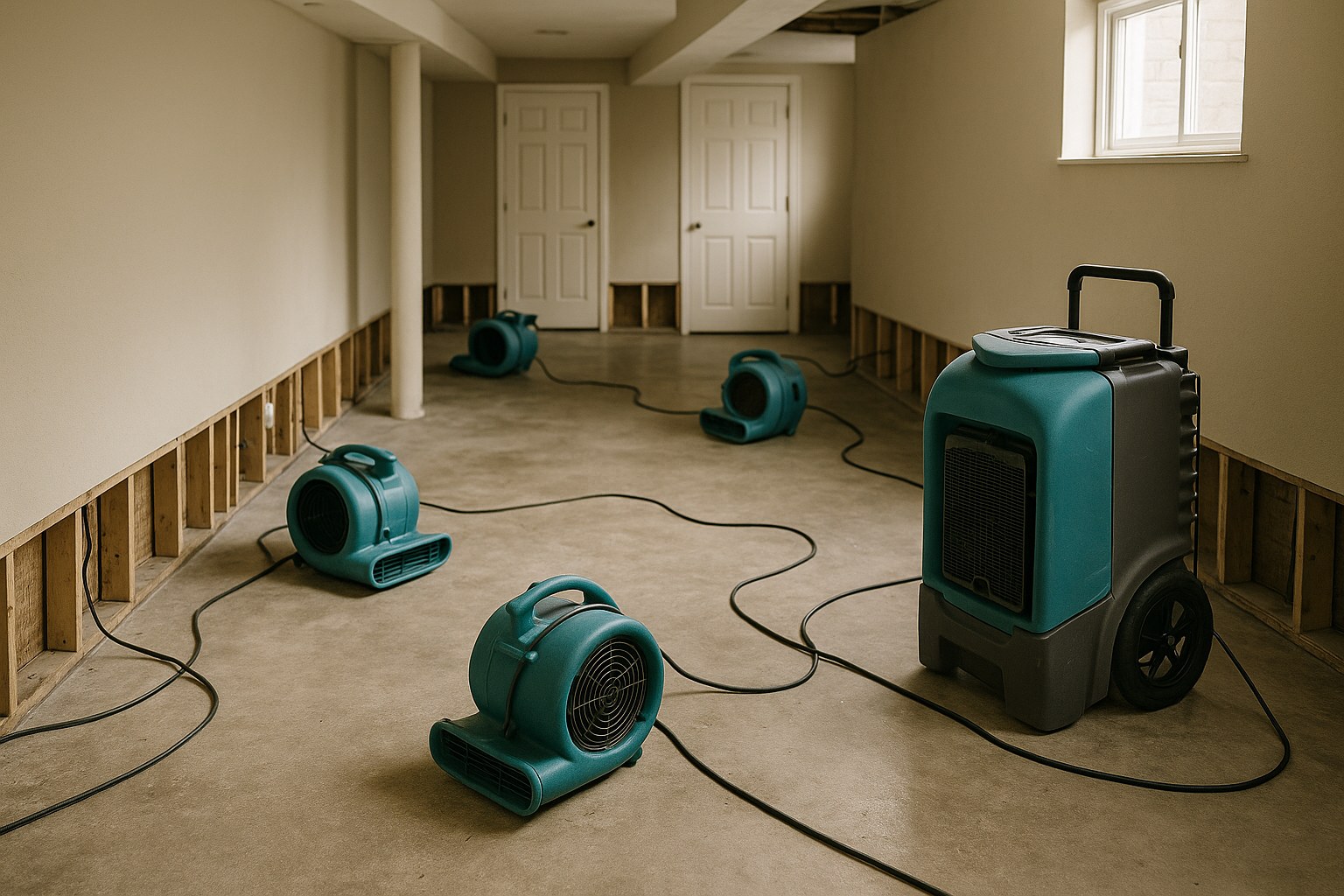
Water Damage Drying Time: How to Know When It’s Done
Most water-damaged homes in Greater Cincinnati dry out in three to seven days. That range is also close to useless on its own, because drying does not finish on a schedule. It finishes when the wet materials read the same as the identical materials in the house that never got wet. If your basement took water during the August 11 storms and someone is talking about pulling the equipment this week, this is what the numbers on your daily monitoring report mean, and what should be true before the air movers come out.
Why three to seven days is a range and not a promise
The spread exists because the same volume of water behaves differently depending on what it soaked into. Water sitting on a sealed concrete slab can be extracted and dried in a couple of days. The same water wicking eighteen inches up the paper facing of drywall, through the sill plate, and into the subfloor is a one to two week job, because the water is no longer on the surface where a fan can reach it.
Three things move the timeline more than anything else: how long the water sat before extraction started, how many layers of material it got into, and whether the structure is holding the water inside an assembly that cannot breathe. A finished basement with framed walls, insulation, and carpet over pad is the slow case. Everything is a sandwich, and the middle of the sandwich dries last.
This matters more than usual after the August 11 and 12 storms. The National Weather Service issued a tornado warning that Tuesday and forecast four to six inches of rain across parts of the area, and more than 180,000 Duke Energy customers lost power, with over 100,000 still out the following day, according to local reporting on the storm. Homes in Cheviot, Walnut Hills, and out toward Mason took water and then sat without electricity. No power means no extraction, no dehumidifier, and no air movement. For a lot of properties the drying clock did not start when the water came in. It started two or three days later, when the lights came back on, and the timeline should be counted from there.
What a drying goal actually is
A competent restoration contractor does not decide a house is dry by looking at it or by counting days. They set a drying goal at the start of the job and then work toward a number.
The drying goal comes from a control reading. The technician finds the same material somewhere in the building that never got wet — the far end of the same subfloor, a stud in a room the water never reached — and measures it. That reading is what normal looks like in your house, in this season, at this humidity. It becomes the target. The industry term for it is the dry standard, described in the ANSI/IICRC S500 standard as a reasonable approximation of a material’s moisture content before the water intrusion, and the S500 asks restorers to set goals that both return materials to an acceptable condition and inhibit microbial growth.
This is why a contractor who cannot tell you the control reading is a problem. Without one, “it’s dry” is an opinion. With one, it is a comparison anyone can check. Readings are usually accepted as dry when they land within a few points of the goal, since meters carry their own margin of error, and for softwood framing the commonly used ceiling is well under twenty percent moisture content, with restorers often targeting the mid-teens to stay clear of conditions that support microbial growth.
There is no universal number that means dry. A framing member at nine percent might be perfectly normal in one house and slightly elevated in another, because the equilibrium moisture content of wood shifts with the temperature and humidity around it. That is exactly why the comparison is to your own building rather than to a chart.
What the meter is actually measuring
You will see two kinds of instrument on a job, and they do not measure the same thing.
- A penetrating or pin meter pushes two probes into the material and measures resistance between them. It reads moisture inside the material, and it is the right tool for wood framing, subfloor, carpet pad, and insulation. It leaves two small holes.
- A non-penetrating or pinless meter is held flat against a surface and reads a shallow depth beneath it without damage. It is used for drywall, plaster, tile, concrete, and cabinetry, and it is excellent for scanning an area quickly to find where the wet zone ends.
The failure mode worth understanding is a surface reading standing in for the whole assembly. A pinless meter run across drywall can report dry while the bottom plate behind that drywall and the subfloor beneath it are still holding water. That trapped moisture does not stay put; it migrates outward after the equipment is gone, which is how a job that looked finished turns into buckled flooring or a musty smell six weeks later. Readings should be taken inside the wet materials, not just across the face of them, and the technician should return to the same marked spots every visit so the numbers describe a trend instead of a new location each day.
Why late August is the hardest time to dry a Cincinnati basement
Dehumidification is the actual work. Air movers do not dry anything; they lift moisture out of materials and into the air. Something then has to remove it from the air, and in an Ohio Valley August that is genuinely difficult, because the air outside is already loaded.
Cincinnati sits in muggy conditions for much of August, with the odds falling from roughly fifty-eight percent at the start of the month to forty-two percent by the end, so even on an improving day the outdoor air often holds more moisture than the air you are trying to dry. This is the reason the most common piece of homeowner advice is wrong here. Opening the basement windows and running a box fan in August frequently makes a wet basement wetter, because you are importing humid air into a cool space where it will give up its moisture on the coldest surfaces available. The correct move is the opposite: close the space up and let a dehumidifier work against a controlled envelope.
The target is a drier interior, not merely a cooler one. The EPA recommends keeping indoor relative humidity below sixty percent and ideally between thirty and fifty percent, and notes that if wet materials are dried within twenty-four to forty-eight hours, in most cases mold will not grow, in its guide to mold, moisture, and your home. That window is also why the outage-delayed starts described above deserve a closer look rather than a standard drying plan.
One point worth stating plainly, because there is a lot of marketing noise around it: there are no federal limits for mold or mold spores, so no one can hand you a spore count and call it a passing grade. The EPA says so directly in the same guide, and adds that sampling cannot be used to check a building against federal mold standards. Anyone selling a number as proof of safety is selling something the science does not support. If you have health concerns about conditions in your home, that is a conversation for your physician, not for a contractor or a blog post.
What should be happening every day the equipment runs
Equipment sitting in a room is not a drying plan. While the fans are running, a technician should be coming back on a regular schedule and recording, at minimum, the moisture content of the affected materials at the same marked locations, the temperature and relative humidity inside the drying chamber, and the conditions outside for comparison.
Good documentation includes photographs of the readings on the first day and the last day, and a note of which meter was used, since different instruments read differently on the same material. Those daily logs are the evidence that the work was done and the basis on which a drying decision was made. They are also, in practice, the paperwork most likely to be requested if questions come up later about the scope of the loss. Insurance policies vary considerably and your own declarations page governs what is covered in your situation; this article is general information, not legal or insurance advice.
If numbers stop moving for two consecutive days, that is information, not a plateau to wait out. It usually means the moisture is somewhere the current equipment configuration cannot reach, and the response is to change the setup — pull a base trim, drill the cavity, add a targeted drying system — rather than to leave the same fans running for another week.
Questions worth asking before the equipment leaves
When the crew says the job is dry, these five questions settle it quickly, and a competent technician will have all five answers on hand.
- What was the control reading, and which unaffected material did it come from?
- What are today’s readings on each affected material, at the same spots you have measured all week?
- Were those taken with pins in the material, or off the surface?
- What is the relative humidity in the space right now, and what was it when you started?
- Can I have the daily monitoring log and the first and final photographs?
If the answers are consistent and the numbers converge with the control, the structure is dry and the equipment should come out. If a question produces a shrug, that is worth resolving before the fans leave the property, because verifying dryness after the fact is considerably harder than confirming it while the equipment is still on site. You can see what completed work looks like on our before and after project gallery.
When drying is not the end of the job
Drying and repair are two separate phases, and conflating them is where budgets go wrong. Structural drying returns materials to their normal moisture content. It does not replace the drywall that was cut out, the trim that was removed, or the flooring that was pulled. Those belong to the rebuild, and on a finished basement the reconstruction is often the larger share of the project. Our water damage restoration work covers the mitigation and drying phase, while complete construction services handles putting the space back the way it was.
Two conditions change the plan. If the water was contaminated — sewage, a backed-up drain, or floodwater that traveled across a yard — the material question is not whether it can be dried but whether it should be kept, and porous materials are typically removed rather than restored. And if visible growth turns up behind a wall once it is opened, that moves the job into mold remediation, which is a containment-based process with its own procedures, not something to be handled by drying the area harder.
If you are looking at a monitoring report you do not understand, or a crew is ready to pull equipment and you are not confident the structure is actually dry, get a second set of readings before the fans leave. Call TRI-WEH Restoration at (513) 231-6653 and we will walk through the numbers with you.